Getting Started with Mini-Z Racing
Everything you need to know to go from your first 'Readyset' to your first race night in Hobart.
Getting Started with Mini-Z Racing
So you’ve seen the videos of palm-sized cars screaming around a foam track and you want in. Welcome. Mini-Z racing is one of the most rewarding branches of the RC hobby—it’s technical, competitive, and significantly more affordable than racing 1:10 scale off-roaders or touring cars.
In this guide, we’ll walk you through the essential steps to get on the track at Tassie Mini-Z Club, from choosing your first car to surviving your first race night.

1. Choosing Your First Car
The most common mistake newcomers make is buying the “fastest” looking car they can find. In Mini-Z racing, “fast” is relative. For club racing in Hobart, you want a platform that is stable, easy to tune, and compliant with our club rules. See What we race for how Box Stock, Open 2WD, AAA, 2500, and F1 fit together on the calendar.
The Kyosho Readyset
For 90% of beginners, the answer is a Kyosho RWD Readyset. This is an all-in-one package that includes a pre-assembled chassis (today that means MR-04 for new kits; you may still see MR-03 on the used market), a highly detailed “Auto Scale” body, and a 2.4GHz transmitter.
What to look for:
- Wheelbase: Look for models with a 98mm wheelbase. These are the most stable and have the widest range of compatible bodies. Popular choices include the McLaren 12C GT3, Audi R8 LMS, or the Mercedes-AMG GT3.
- Chassis: Prefer a new MR-04 Readyset — updated front end, lower centre of gravity, and what our club rules are written around. A used MR-03 can still be a budget path, but check tech before you assume it matches the same Box Stock sheet as MR-04.
- Avoid EVO initially: Kyosho “EVO” models are sold as chassis sets without a radio. They are designed for advanced racing and are often restricted in beginner classes. Stick to the standard Readyset to start.
- Want a better wheel without EVO? Kyosho’s Flysky FS-RM005 module in a Noble NB4 / NB4+ controls a Readyset on Mini-Z FHSS while the car keeps its stock receiver/ESC — see Kyosho FS-RM005 (82151-11). That is not the same as fitting an EVO receiver in the chassis; check Box Stock wording for the meet before you change anything on the car.
2. The Essential Extras
Your Readyset comes with the car and the radio, but you’ll need a few more items to actually go racing.
Batteries and Charging
Mini-Z cars run on four AAA batteries. Do not use alkalines; they don’t have the “punch” required for racing and will fade quickly. You need high-quality rechargeable NiMH (Nickel Metal Hydride) batteries.
- The Cells: Look for 750mAh to 800mAh cells. The Kyosho Speed House 800HV or PN Racing 750s are excellent. Even standard Eneloops will get you started, though they won’t be as fast.
- The Charger: You need a smart charger that can handle individual AAA cells. A “trickle charger” won’t cut it. Look for something like the SkyRC NC1500 or the ISDT N8. These chargers ensure your batteries are peaked and ready for each heat.
Tyres: The Only Upgrade You Really Need
The rubber tyres that come in the box are designed for display, not racing. On our RCP foam tracks, they will have almost no grip.
A standard starting setup for our track is:
- Front: 30-degree (Medium) or “Firm” slick tyres.
- Rear: 20-degree (Soft) or “Super Soft” radial tyres.
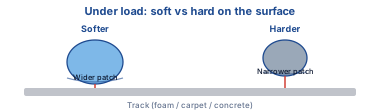
Tyres are the single biggest tuning factor. If the car is sliding too much, go softer in the rear. If it’s “traction rolling” (tipping over in corners), go harder in the front.
3. Basic Preparation
Before you head to the club, there are a couple of small things you can do to make your car more reliable:
- Check the Wheel Nuts: Replace the plastic ones with aluminium lock nuts if you can. They won’t vibrate loose during a 5-minute heat.
- The T-Plate: The “T-plate” is the plastic piece that connects the motor pod to the main chassis. Swapping the stock plastic one for a carbon fibre version (Medium or #4) will make the rear end of the car much more consistent.
- MR-04 front end: Skip old MR-03 “kingpin flip” tutorials — they do not apply the same way on MR-04. Use the manual for your Readyset and ask at tech if you want a lower nose or less binding; the club can show you what is legal for the meet.
4. Learning to Drive
Mini-Z racing is about precision, not top speed. The tracks are tight, and the margins for error are millimetres.
Consistency Over Speed
Your goal for your first few nights shouldn’t be to set the fastest lap. It should be to complete a 5-minute heat without crashing. Every time you hit a wall, you lose 2-3 seconds waiting for a marshal to reset you. Slow down, hit your apexes, and stay off the barriers.
Throttle Control
Most beginners treat the throttle like an on/off switch. In a Mini-Z, you rarely need 100% throttle except on the main straight. Learn to “roll” the car through corners. Lift off the throttle early, let the car’s natural drag slow it down, and only apply power once your wheels are straight.
5. Your First Race Night
When you arrive at Tassie Mini-Z Club, the first thing to do is find the Race Director and introduce yourself. We’re a friendly bunch and we’ll help you get your car through “Tech Inspection.”
What to Expect
- Practice: Most nights start with open practice. This is your time to get used to the track layout.
- Qualifying: You’ll run 2 or 3 heats (usually 3-5 minutes each). Your best result determines where you start in the finals.
- The Finals: This is the main event. You’ll be grouped with drivers of similar speed.
Marshalling
In RC racing, when you aren’t driving, you’re marshalling. This means standing at a designated spot on the track and quickly resetting cars that have crashed. It’s the most important job in the building, and it’s how we keep the racing moving.
Summary Checklist
- Buy a Kyosho RWD Readyset (98mm wheelbase preferred).
- Get 8-12 NiMH AAA batteries and a smart charger.
- Buy a set of racing tyres (30f/20r is a good start).
- Practice smooth driving at home or during open track time.
- Come to a race night with an open mind and a willingness to learn.
We look forward to seeing you on the grid in Hobart.