
Race Classes Explained
What each race class means, what's allowed, and where to start.
We run multiple classes so that factory-fresh cars aren’t lining up against full-mod rockets. Here’s what each class means.
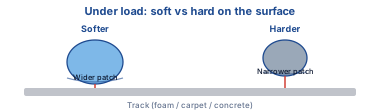
On a club night the banners and flight cases might be smaller, but the cadence is the same DNA: short heats, a driver’s stand, marshals at the tiles, and everyone sharing the same surface between the barriers — whether you are in Box Stock, chasing an Open, AAA, or 2500 main, or lining up in F1.
Box Stock
The beginner class. Cars must be factory-spec Kyosho MR-04 (RWD Readyset rules as published for the meet) with no motor, electronic, or chassis modifications unless the round brief says otherwise. Tyre choice is free but must be standard size. This is where most people start and where some of the closest racing happens.
Allowed:
- Any Kyosho Mini-Z RTR car (MR-04 RWD for our touring-style classes, MA-030 for AWD, etc. — check the round brief)
- Transmitter: bundled KT-531P or Flysky Noble NB4 / NB4+ with Kyosho FS-RM005 (Mini-Z/FHSS) so the car can stay on stock Readyset electronics — follow Kyosho binding/firmware notes; confirm anything else with the round brief
- Body shell changes (cosmetic only)
- Tyre changes (standard size)
- Battery choice (AAA NiMH recommended)
Not allowed:
- Motor swaps or motor modifications
- Aftermarket electronics (gyros, ESCs)
- Chassis modifications or hop-up parts
- LiPo batteries
Open 2WD
Modified rear-wheel-drive. Anything goes within reason. Aftermarket motors, electronic upgrades, chassis tuning parts — all permitted. This class rewards setup knowledge and driving skill.
Common upgrades:
- PN Racing or Atomic brushless motor
- Upgraded ball differential
- Aluminium knuckles and suspension arms
- Performance tyres (wide rears common)
Open 4WD
Modified all-wheel-drive. Same open rules as Open 2WD but for AWD chassis (MA-030, MA-020). AWD cars handle differently — more stable in corners, less rear-end drama, but heavier.
AAA
AAA-spec Mini-Z. We run AAA as its own class with its own rule set — not the same as Box Stock or Open. If you are building for AAA, confirm limits (motor, ESC, weight, tyres) against the club sheet for that round or ask the race director before race night.
2500
Brushless touring — speed tier. 2500 is a separate touring class with motor and electronics limits published per meet so grids stay close without being as tight as Box Stock. It is not “Open with a different sticker,” and it is not interchangeable with AAA unless the round brief says so. Confirm your motor, ESC, battery, and tyres against the 2500 sheet before race night.
F1
Open-wheel Formula Mini-Z. F1-class cars use Formula-style bodies and the handling character of an open-wheel layout — a different challenge from touring-style Mini-Z. Enter F1 when your car and setup match the published F1 rules for the meet.
Driver (half-speed box stock)
Box stock, half pace. Driver uses the same hardware and rules as Box Stock (factory Kyosho Mini-Z, brushed motor, NiMH, no hop-up electronics), but the class is run at half speed — usually with a throttle limit on the radio — so juniors, complete beginners, or anyone who wants stock tech without full race pace can learn lines and race format safely.
Which class should I choose?
| Situation | Recommendation |
|---|---|
| First time racing | Box Stock, or Driver if you want half-speed stock |
| Junior or learning race format | Driver (half-speed box stock), then Box Stock |
| Have a stock RTR car | Box Stock or Driver |
| Want to tinker and tune | Open 2WD or Open 4WD |
| Building for AAA, 2500, or F1 | Check the event class list and published rules |
| Not sure | Start Box Stock or Driver, move up when you’re ready |
There’s no pressure to move up. Box Stock is competitive and fun at every skill level. Some of our quickest drivers still race Box Stock by choice.
Class rules on race night
Classes are called in order. You can enter multiple classes if you have the cars for it. Timing is handled by LiveRC with transponder-based lap counting.