
Setup 101: Mastering the Front End
A beginner-friendly guide to camber, caster, kingpin oil, and ride height adjustments for your Mini-Z.

Entering the world of Mini-Z tuning can feel like learning a new language. Words like “camber,” “caster,” and “kingpin dampening” are tossed around the pits, but for a beginner, it’s hard to know where to start. The good news is that the Kyosho MR-04 — and the earlier MR-03 many of us learned on — are beautifully engineered platforms that respond predictably to changes.

In this first part of our Setup 101 series, we are focusing on the front end. Your front suspension is responsible for two main things: getting the car into the corner (turn-in) and keeping it stable on the straights. Here is a breakdown of the core adjustments and what they actually do to the “feel” of your car.
Camber: The Tilt of the Wheel
Camber refers to the vertical angle of your wheels when looking at the car from the front.
- Negative Camber: The tops of the tyres lean inward toward each other.
- Neutral Camber: The wheels are perfectly vertical (0 degrees).
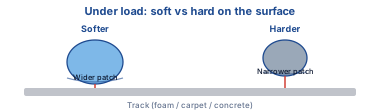
How it works: When your car enters a corner, the body rolls slightly. This roll causes the outside tyre to tilt. By starting with a bit of negative camber (usually 1.0 to 1.5 degrees), you ensure that when the car leans in the corner, the outside tyre’s contact patch is perfectly flat against the track.
The Feel: More negative camber generally provides more mid-corner and exit steering. If your car feels like it’s “pushing” (understeering) in the middle of a turn, adding a bit of negative camber can help the front end bite. However, too much camber can reduce your braking performance on the straights, as the tyre isn’t perfectly flat when the car is level.
Caster: Straight-Line Stability
Caster is the angle of the steering pivot when viewed from the side. Think of the front wheels on a shopping trolley—they have a lot of caster, which is why they want to point straight when you push the trolley forward.
How it works: Most Mini-Z front ends allow for small adjustments in caster (usually 0 to 2 degrees).
The Feel: Adding more caster makes the car much easier to drive on the straights. It increases the “self-centering” effect of the steering, making the car feel less “twitchy.” This is a great adjustment if you find yourself constantly weaving on the straight. The trade-off is that the steering can feel slightly “heavier” and less responsive during the initial turn-in of a corner.
Kingpin Oil and Grease: The “Shock Absorber”
One of the most unique aspects of the Mini-Z is that it doesn’t have traditional oil-filled shock absorbers on the front end. Instead, it uses a sliding kingpin design. To control the speed at which the suspension compresses and rebounds (dampening), we use silicone oil or heavy grease directly on the kingpin shaft.
How it works: Without any lubrication, the front end will “pogo” or bounce rapidly after hitting a bump or during a quick steering input. By applying a thick substance—like 15,000wt or 30,000wt silicone grease—you create friction that slows this motion down.
The Feel: Properly dampened kingpins make the car feel “planted.” It stops the front of the chassis from bouncing, which makes your steering inputs much more predictable. If the car feels erratic or “nervous” over small bumps on an RCP track, it’s likely time to re-grease your kingpins.
Ride Height: Managing the Centre of Gravity
Ride height is the distance between the bottom of the chassis and the track surface. On a Mini-Z, this is adjusted using small shims or spacers placed above or below the steering knuckles.
How it works: Lowering the ride height lowers the car’s centre of gravity (CG). This is the most effective way to prevent “traction rolling” on high-grip surfaces.
The Feel: A lower car is a more stable car. However, there is a limit. If you go too low, the chassis will “bottom out” and scrape the track under heavy braking or in hard corners. When the chassis hits the ground, it momentarily lifts the tyres, causing a sudden and total loss of grip. The goal is to run the car as low as possible without ever hearing that tell-tale “scrape” on the track surface.
Where to Start?
If you are just starting out, don’t try to change everything at once. Our recommended “baseline” for a new racer is:
- Camber: -1.5 degrees.
- Caster: 0 or 1 degree.
- Kingpin Grease: 15,000wt (medium).
- Ride Height: Horizontal (level with the ground).
Make one change at a time and drive for at least ten minutes to see how it affects your lap times and your confidence. In our next post, we will move to the back of the car and look at T-plates and motor pods. Until then, happy tuning!